
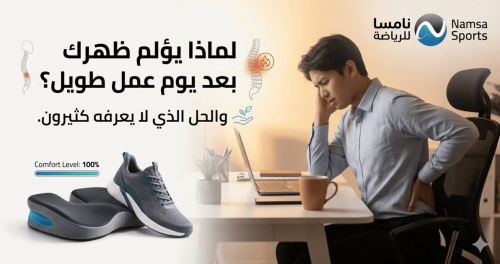
You finish your workday and the first thing you feel is heaviness and pain in your lower back. You attribute it to stress, a long shift, or perhaps age. But in many cases, the real cause is much lower down—specifically, in your feet.
The hidden relationship between your shoes and your back
The human body works as an integrated chain. When you stand, your foot is the first point of contact with the ground, and everything that happens there is reflected upwards: ankle, knee, hip, all the way to the back.
If your shoes:
- Your arch is not supported → Your ankle bends inwards → The direction of your knee is affected → Your hip joints are compressed → Pressure is reflected onto the lumbar vertebrae.
- Its sole is hard and does not absorb shocks → Every step sends a vibration wave from the foot to the spine.
- Tight or uncomfortable → You change the way you walk to avoid pain → Muscle tension develops in the back and pelvis.
This chain operates daily, and its cumulative effect is evident at the end of each workday.
Who are the most vulnerable?
Nurses and doctors: They stand between 8 and 12 hours a day, often on hard floors such as ceramic and marble.
Teachers: They move between classrooms and stand in front of the blackboard for hours on end.
Bank and service employees: They stand behind counters for long periods without sufficient movement.
Factory and warehouse workers: They stand on hard surfaces and often carry extra weights.
What should the right shoe do?
1. Arch support
The arch is the natural barrier that absorbs shocks. A shoe without arch support causes the foot to collapse with every step, and this produces the stress chain we explained above.
2. Shock absorption
A good insole like Skechers' Memory Foam molds to your foot and absorbs a large part of the shock before it reaches the joints.
3. Proper weight distribution
The right shoes distribute your body weight across the entire foot instead of concentrating it on specific points such as the heel or the front of the foot.
4. Lateral stability
A shoe that supports the ankle from both sides prevents inward or outward deviation that strains the leg and back muscles.
Technologies that actually solve the problem
Skechers Arch Fit® was developed in collaboration with podiatrists. The insole is designed to mimic natural arch support. Internal studies conducted by Skechers have demonstrated a significant reduction in foot stress with consistent use.
Memory Foam® is a foam that responds to heat and pressure and molds specifically to your foot. It acts as a personalized cushion, not a universal insole for all shapes.
Max Cushioning® is designed for long shifts exceeding 8 hours. The extra-thick sole protects joints from daily impact.
Additional procedures complement the role of the shoe
Good shoes are essential, but there are steps that enhance their effect:
- Morning stretching exercises: 5 minutes of leg and back stretching before starting work noticeably reduces muscle tension.
- Change your standing position: Every hour, shift your weight from one foot to the other and avoid standing completely still.
- Supportive socks: Compression socks help with blood circulation and reduce leg swelling at the end of the day.
- Avoid very hard surfaces: If possible, use an anti-fatigue mat in your stationary work area.
When should you visit the doctor?
If back pain persists after changing your shoes and following the tips above, or if the pain is severe and radiates down your leg, it's important to consult a physiotherapist or orthopedist. Shoes can solve a significant part of the problem, but some cases require specialized intervention.
Summary
Back pain after work is not inevitable. In many cases, changing shoes to ones that support your arch and absorb shock makes a difference that a person notices from the first week.